
Commentary written by Dr Eva Gelinsky and Dr Angelika Hilbeck
Berlin, 6 September 2018
Einseitige Angriffe und eine voreingenommene Berichterstattung zum EuGH Urteil über neue Gentechnikmethoden entlarven ein anmassendes und unaufgeklärtes Wissenschafts- Demokratie- und Rechtsverständnis
One-sided attacks and biased reporting of the ECJ judgement regarding new genetic engineering methods reveal an arrogant and unenlightened understanding of science, democracy and law
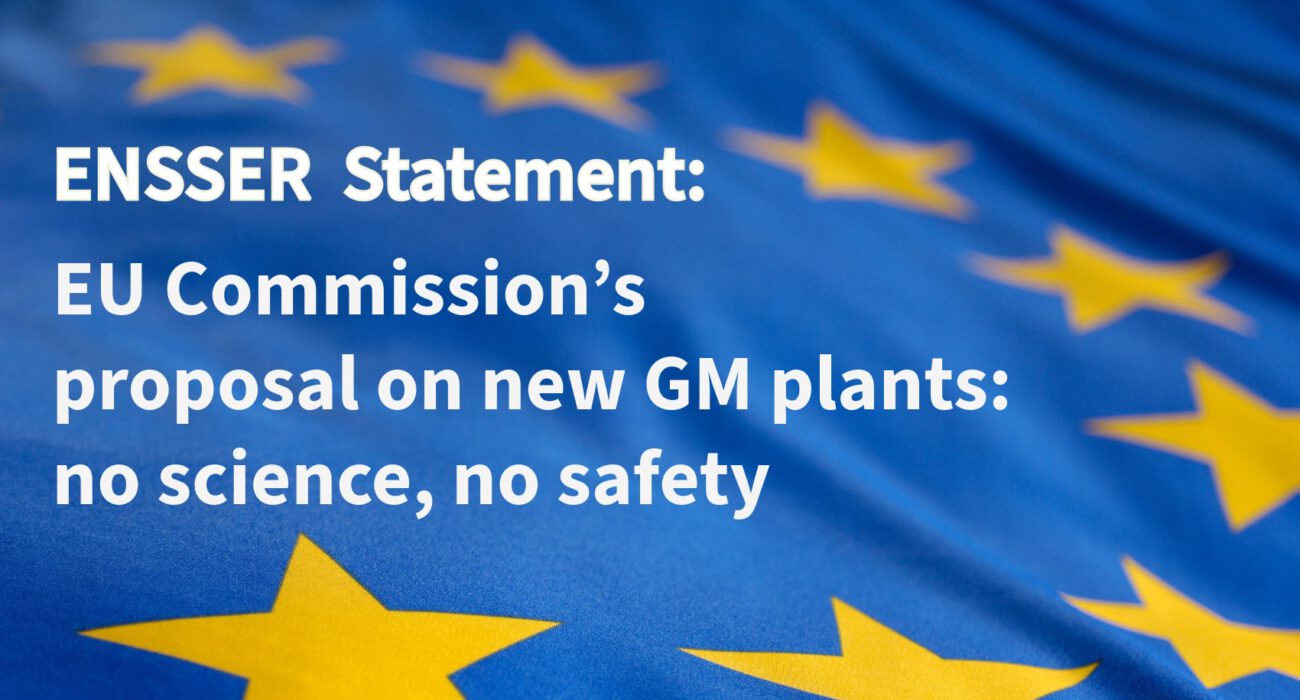
ENSSER STATEMENT:
Products of new genetic modification techniques should be strictly regulated as GMOs
New genetic modification techniques (NGMTs) are increasingly being developed and applied to generate new varieties of food crops and livestock animals. They are also being used for other purposes, such as to develop gene drives. They include – but are not restricted to – CRISPR-Cas/Cpf, TALENs, zinc finger nucleases, oligonucleotide directed mutagenesis, cisgenesis, transgrafting, and RNA-dependent DNA methylation. These techniques are sometimes referred to as “new (plant) breeding techniques” (NBTs or NPBTs)...
Full statement > Chinese > Dutch > French > First signatories > Press Release >
ENSSER Energy Workshop
“A World We Want” within the boundaries of planet earth: Finding a common and scientific fact-based language for the energy transition
ENSSER conducted a workshop with 13 scientists on 13 December 2017 on matters related to the question "Why do we need to fill the knowledge gap about energy usage and energy resources for a transition towards a sustainable and socially acceptable and possible future way of life?"
Workshop Documents >
New research finds common herbicides cause antibiotic resistance
New University of Canterbury research confirms that the active ingredients of the commonly used herbicides, RoundUp, Kamba and 2,4-D (glyphosate, dicamba and 2,4-D, respectively), each alone cause antibiotic resistance at concentrations well below label application rates. UC Molecular Biology and Genetics academic, Professor Jack Heinemann, of the School of Biological Sciences, in UC’s College of Science, says the key finding of the research was that “bacteria respond to exposure to the herbicides by changing how susceptible they are to antibiotics used in human and animal medicine.”
available download: PR_UC research finds common herbicides cause antibiotic resistance
Press Release from the Annual Assembly 2017 in Athens
The European Network of Scientists for Social and Environmental Responsibility, at its 7th annual assembly in Athens this year, has expressed its sympathy and solidarity with the victims of the recent disastrous floods in Mandras, Attika. Participating scientists at the meeting, from many European nations, discussed this event and the factors increasing its severity, as well as similar ones elsewhere in the world. It released the following statement:
Read Press Release >
ENSSER. WHO WE ARE.
ENSSER · The European Network of Scientists for Social and Environmental Responsibility
ENSSER is committed to:
- Transparent, high quality scientific information that focuses on the ecological, health, and socioeconomic aspects of technology use.
- The assessment of alternative options within technology policy, strengthening innovation and long term sustainability, meanwhile prioritising public and environmental safety.
The objective of ENSSER is the advancement of public-good science and research for the protection of the environment, biological diversity and human health against adverse impacts of new technologies and their products.
ENSSER advocates benign and peaceful use of scientific discoveries and technological developments, while expanding diverse approaches to assess their utility and safety in society.
ENSSER considers that critical, independent and transparent analyses of technology options can best promote sustainable and humane technology development that addresses both current and future social and environmental problems.
ENSSER promotes the critical European and international discourse on new technologies, their impacts and their regulation. As scientific and technological advances, are increasingly driven by private interest, health and environmental safety information needs often lag behind. As a result, the relationship between science, society and environment in science policy should be restructured to better protect the public interest.
ENSSER promotes critical thinking to help reshape current models towards more democratic and participatory agenda-setting processes. This requires creating spaces for scientific information independent from economic and political influence, and includes the identification, use, and quality assessment of scientific, lay, local, traditional and other knowledge sources.
ENSSER. WHAT WE DO.
supporting and protecting independent and critical scientific research for the protection of the environment, biological diversity and human health against negative impacts of new technologies and their products;
promoting a democratic approach of the choice of scientific and technical options for practical implementation; and
developing responsible approaches to the assessment of risks and benefits of existing and emerging technologies.